
Learning does not have to happen only inside the classroom. With simple games, stories and creative activities, parents can make everyday learning enjoyable at home. Here are some learning activities for preschoolers at home that help children learn, explore and grow with confidence.
Why Home Learning Activities Are Important
Preschool children learn naturally through play, exploration and everyday experiences. Simple activities at home can help children develop communication, creativity, memory, early mathematics and problem-solving skills.
The goal is not to make home feel like a classroom. Instead, parents can create small moments of learning through fun, conversation and creative play.
Storytelling and Picture Books
Choose a colourful picture book and read it together with your child. Ask simple questions about the characters and pictures. Encourage your child to tell you what they think will happen next.
Helps develop: Vocabulary, listening skills, imagination and communication.
Drawing and Colouring
Give your child paper, crayons or colouring pencils and let them draw freely. You can also ask them to draw their family, favourite animal, home or something they saw outside.
Helps develop: Creativity, concentration, hand control and self-expression.
Counting Games
Use toys, blocks, fruits or household objects for simple counting games. Ask your child to count how many objects they can see or group them into small sets.
Helps develop: Number recognition, counting and early mathematical thinking.
Shape and Colour Hunt
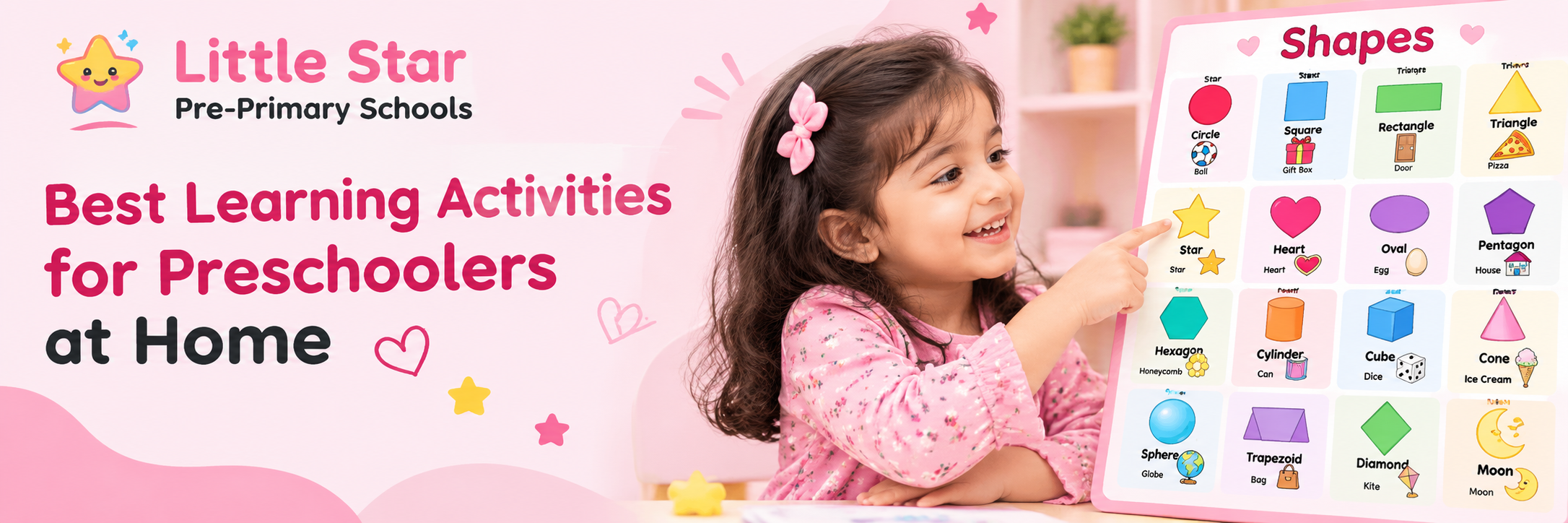
Turn learning into a fun search game. Ask your child to find something red, something blue, a circle, a square or another familiar shape around the house.
Helps develop: Observation, colour recognition, shape recognition and vocabulary.
Puzzles and Matching Games
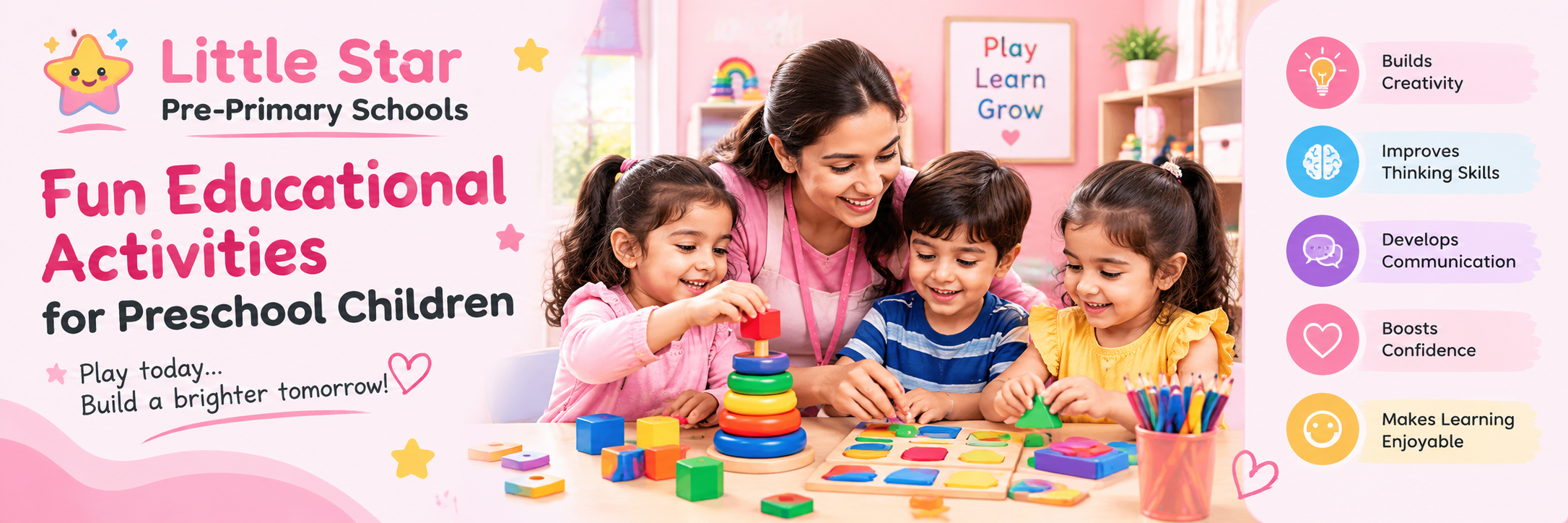
Simple puzzles and matching activities can be great learning tools for preschoolers. Try matching animals, colours, shapes or everyday objects.
Helps develop: Memory, concentration, observation and problem-solving.
Music, Rhymes and Movement
Sing nursery rhymes together and encourage your child to clap, dance or move along with the rhythm. Children can learn new words and patterns while enjoying music.
Helps develop: Language, memory, rhythm and physical coordination.
Simple Sorting Activities
Give your child safe household objects such as blocks, toys or coloured items and ask them to sort them by colour, size or type.
Helps develop: Logical thinking, classification and early mathematics.
Nature Exploration
Take your child outside and talk about trees, flowers, birds, insects and the weather. Ask simple questions and encourage your child to observe the world around them.
Helps develop: Curiosity, observation, vocabulary and awareness of nature.
Letter and Sound Games
Introduce letters through simple games. For example, choose a letter and ask your child to find an object that starts with that sound.
Helps develop: Early literacy, vocabulary and sound recognition.
Helping with Everyday Tasks
Everyday activities can also become learning opportunities. Let children help with simple age-appropriate tasks such as arranging toys, sorting clothes or setting the table with safe items.
Helps develop: Independence, responsibility, confidence and practical skills.
Tips for Making Home Learning Fun
- Keep activities short and suitable for your child’s age.
- Allow your child to explore and make mistakes.
- Use everyday objects whenever possible.
- Praise effort rather than expecting perfection.
- Give children opportunities to choose activities.
- Make learning playful instead of stressful.
Make Every Learning Moment Special
The best learning activities for preschoolers at home are often simple activities that allow children to play, explore and communicate with their parents.
At Little Star Pre-Primary Schools, we believe that young children learn best when they feel happy, supported and encouraged to explore. With the right balance of play, creativity and learning, every day can become an opportunity to discover something new.
Frequently Asked Questions
What are good learning activities for preschoolers at home?
Storytelling, drawing, counting games, puzzles, sorting, music, shape activities and nature exploration are simple learning activities for preschoolers at home.
How can parents make preschool learning fun at home?
Parents can use games, stories, songs, creative activities and everyday experiences to make learning enjoyable and engaging for children.
How long should a preschool learning activity be?
Preschool activities should generally be short and flexible. Parents can follow the child’s interest and take breaks whenever the child becomes tired or loses interest.
Can everyday household activities help children learn?
Yes. Sorting objects, counting toys, arranging belongings and helping with simple age-appropriate tasks can support early learning and independence.